
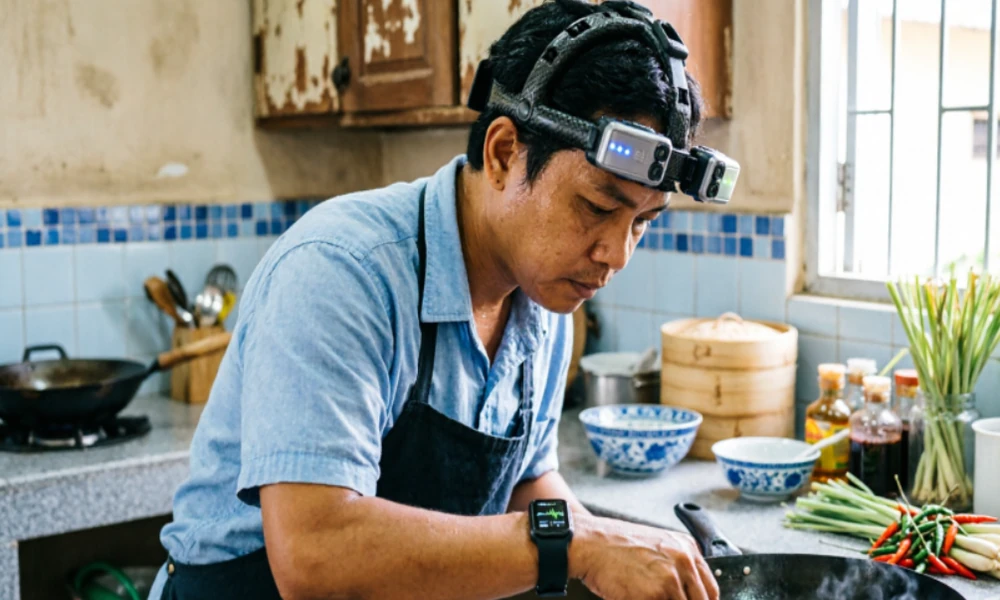
Humyn Labs is a multimodal human data company that collects, validates, and ships training data for physical AI across sound, sight, mobility, and touch. Every dataset passes eight checks before it reaches a buyer. This post walks through the Humyn Labs data pipeline check by check, so you can audit it before you commit compute.
The eight checks, in pipeline order:
- Contributor verification before capture
- Collection in real deployment markets
- Four modalities synchronized at capture
- Automated validation that catches invisible failures
- A discard rate that stays under 15 percent
- Episode level annotation built for robot learning
- BRIDGE benchmark evaluation before delivery
- Training ready formats with full provenance
1. Contributor Verification Before Capture
Every contributor in the Humyn Labs network is identity verified before recording a single frame.
Each data point ships with verified network-level provenance covering environment and timestamp. Verification is anchored on a blockchain ledger across the verified contributor network, so the record cannot be edited quietly after the fact. Scraped web data offers none of this. You often cannot name the source, confirm consent, or prove a license, and that gap has turned into real legal exposure across the industry. Procurement teams know it, and vendor questionnaires now ask for it. When your counsel asks where a specific training example came from, the answer here is a lookup, not an investigation. Government and defense buyers ask for exactly this chain during procurement.
Why it matters: you can trace any example to a named, consenting source before legal review even starts.
2. Collection in Real Deployment Markets
Humyn Labs runs its pipeline in more than 20 countries across the Global South and other emerging regions.
These are the primary deployment markets for physical AI, and they look nothing like the environments most training data comes from. Western trained models have zero exposure to a working kitchen or workshop in these markets. Different appliances. Different layouts. Different light. Distribution shift is the failure mode that surfaces after deployment, when it costs the most to fix. Specific market coverage beats a vague diversity claim, so hold every vendor to the same standard. Ask which deployment markets they actually cover, then check that against the markets your product will ship into. The verified contributor network already sits in these markets, so coverage scales without a recruiting cycle each time.
Why it matters: your model trains on the environments it will actually operate in, not an approximation of them.
3. Four Modalities Synchronized at Capture
Sound, sight, mobility, and touch are fused into one co registered signal at the moment of recording, not aligned in post production.
A child learns to catch a ball with every sense at once. Hearing it leave the bat. Tracking it through space. Feeling their feet shift under them. Physical AI needs that same unified signal, and alignment done after capture introduces timing drift that quietly corrupts it. Humyn Labs records 6DoF pose, hand skeletal tracking, and spatial mapping on a single clock, so sound, sight, mobility, and touch arrive as one signal. Sight collection has passed 10,000 hours across more than 20 countries on this setup, with episode level annotation applied on top.
Why it matters: you train on the same fused signal your robot will need at inference time.
4. Automated Validation That Catches Invisible Failures
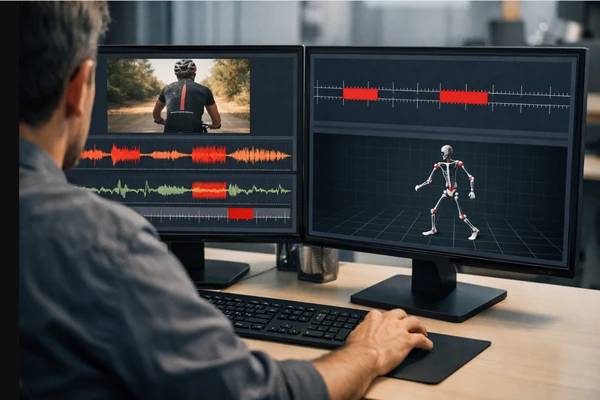
Every modality passes automated validation for capture faults, sync drift, and corrupted segments before a human annotator touches it.
Some failures are invisible to the eye. Mobility data that drifted two degrees. Sound that slipped 40 milliseconds behind sight. A depth channel that flatlined for a minute. Watching the footage back reveals none of it. The Humyn Labs product stack includes validation tools built for exactly these failures, plus processing pipelines that strip noise before labeling begins. Annotation is the expensive stage, so QC runs first. Broken data gets caught while it is still cheap to catch, and annotators only ever see streams that passed.
Why it matters: you never pay annotation rates on data that was broken at capture.
5. A Discard Rate That Stays Under 15 Percent
Humyn Labs discards under 15 percent of collected sight data and tracks that number as a pipeline health metric.
The discard rate tells you two things at once. A vendor that discards nothing is not checking anything. A vendor that discards half has a capture problem, and you are funding the waste either way. Controlled rigs, trained contributors, and validation before annotation keep the Humyn Labs figure under 15 percent, while multilayer QC still removes the real failures. Ask any data vendor for this single number. If they cannot produce it, they are not measuring it, and you will find out what it was after your training run instead of before your purchase.
Why it matters: you pay for data that ships, and you can see exactly how much never made it.
6. Episode Level Annotation Built for Robot Learning
Data is labeled at the episode level, preserving the full arc of a task from first movement to completion.
Frame level labels lose intent. A hand near a cup could be reaching, withdrawing, or hovering, and only the full episode tells you which. Humyn Labs structures manipulation data as complete episodes with 7 DoF arm kinematics, whole body pose, and spatial mapping attached to each one. That structure matches how imitation learning and robot foundation models actually consume demonstrations, from first contact through task completion. For the research background on why demonstration structure drives policy quality, the guide to robot learning from human demonstration on this blog covers it in depth.
Why it matters: your policy learns complete tasks, not disconnected frames.
7. BRIDGE Benchmark Evaluation Before Delivery
Datasets pass through BRIDGE, the Humyn Labs evaluation layer, before any buyer sees them.
Evidence beats assurance. The audio corpus stands at 50,000 hours across 33 languages, recorded in real environments with rare dialects and code switching included, and every batch is BRIDGE evaluated before it ships. That corpus generates revenue today, which is its own kind of proof. Evaluation before delivery flips the usual sequence in this market. You see performance evidence before committing compute, instead of finding out after a failed run explains itself in your eval suite. Request a BRIDGE sample and run it against your own benchmarks first.
Why it matters: you get eval evidence before your first GPU hour, not after.
8. Training Ready Formats With Full Provenance
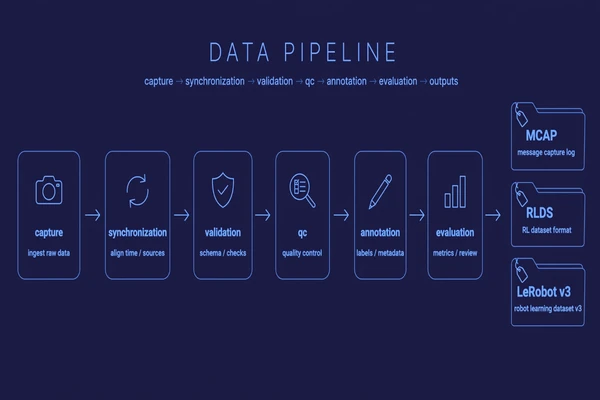
Data ships in MCAP, RLDS, and LeRobot v3 with provenance metadata attached to every record.
Format friction is a silent tax. Two weeks of conversion scripts before training starts is common, and nobody budgets for it. Humyn Labs runs one integrated pipeline through synchronization, validation, processing, QC, and benchmark evaluation, then ships in the formats robotics teams already train on. MCAP for raw multimodal logs. RLDS for episode structure. LeRobot v3 for the training loop itself. Provenance fields travel with each record, so the audit trail survives the handoff into your own stack instead of dying at the vendor boundary. Delivery is the eighth check, and it is checked, not assumed.
Why it matters: your engineers start training the day data arrives.
How the Checks Compare With Typical Data Sourcing
Here is how the Humyn Labs data pipeline compares with typical scraped or brokered data on the same eight checks.
| Check | Humyn Labs | Typical scraped or brokered data |
| Source identity | Verified network-level provenance, blockchain verified | Often unknown or unverifiable |
| Geography | More than 20 countries across the Global South | Skewed to North America and Western Europe |
| Modality sync | Fused at capture on one clock | Aligned in post, if at all |
| Quality control | Multilayer, automated plus human review | Spot checks |
| Evaluation | BRIDGE tested before delivery | Discovered after training |
| Formats | MCAP, RLDS, LeRobot v3 | Mixed, needs conversion |
| Licensing | Consented and traceable | Contested, litigation exposure |
Where This Pipeline Runs
Everything above describes one system. The Humyn Labs data pipeline handles collection, validation, multilayer QC, annotation, and human in the loop review as a single flow, from a verified contributor network in more than 20 countries to training ready delivery. If you are scoping physical AI data or voice data, the how it works page shows each stage, and the datasets page carries samples you can test today. No budget field. No company size dropdown. Tell us what you are building and we will scope your data pipeline. Talk to us.
Questions Buyers Ask About Humyn Labs
What does Humyn Labs do?
Humyn Labs is a multimodal human data company. It collects, validates, annotates, and ships training data for physical AI and voice systems across sound, sight, mobility, and touch, using a verified contributor network in more than 20 countries. Buyers include frontier labs and enterprise AI teams.
How does Humyn Labs collect training data?
Verified contributors record real tasks in real environments capturing sound, sight, mobility, and touch on a single clock. The modalities fuse into one co registered signal at capture, then pass validation, multilayer QC, and annotation before delivery. Collection runs across more than 20 countries.
What data formats does Humyn Labs deliver?
Data ships in MCAP, RLDS, and LeRobot v3, the formats robotics training stacks already consume. Every record carries verified network-level provenance metadata covering environment and timestamp, so traceability survives the move into your infrastructure. No conversion scripts are needed before training starts.
How does Humyn Labs verify data quality?
The Humyn Labs data pipeline runs quality in layers. Automated validation screens for capture faults and sync drift, processing removes noise, multilayer QC reviews annotations, and BRIDGE evaluates finished datasets before delivery. The sight pipeline discards under 15 percent of captured data and tracks that rate.
Which countries does Humyn Labs collect data in?
The pipeline runs in more than 20 countries across the Global South and other emerging regions. These are primary deployment markets for physical AI, so the data covers environments most western sourced datasets never touch. Country coverage is listed per dataset on the datasets page.
Can I test Humyn Labs data before buying?
Yes. Sample datasets, including BRIDGE evaluated audio, are available from the datasets page. Run a sample against your own eval suite first, then scope a full collection through the contact page. There is no budget field and no company size dropdown in the form.
Audit It Yourself
The Humyn Labs data pipeline is built to be audited, so audit it. Request a sample, run your own evals, and test every claim in this post against the results. Talk to us when you are ready to scope a collection.